

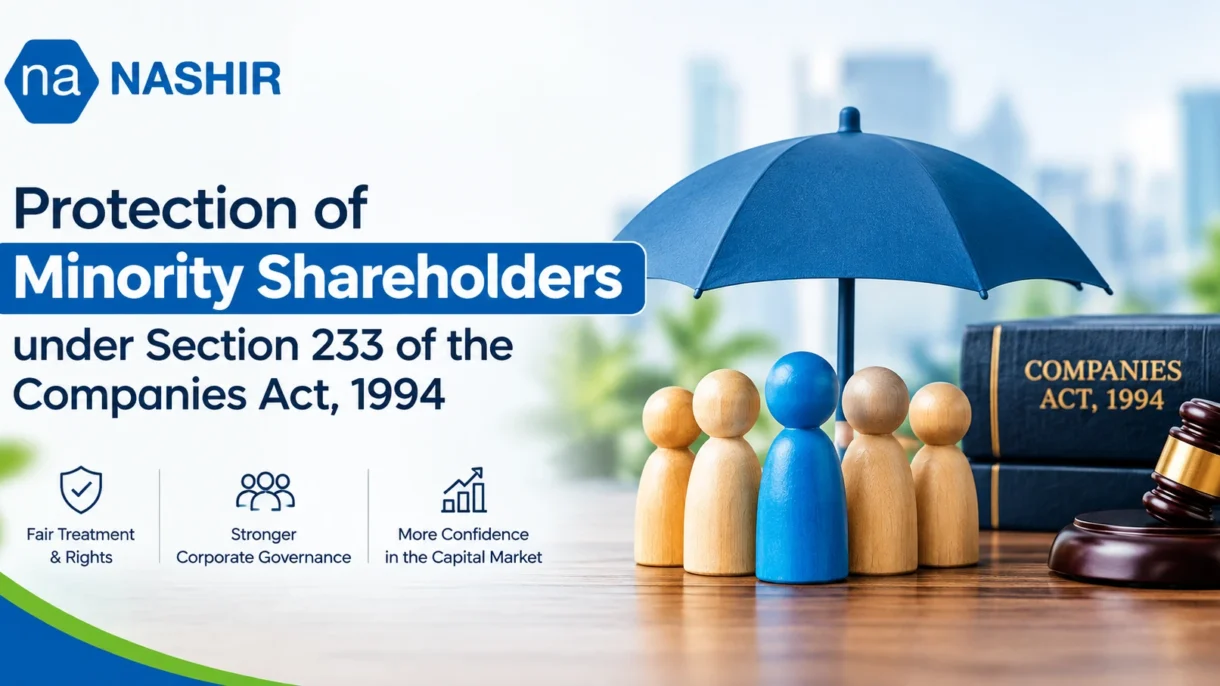
Section 233 of the Companies Act, 1994 gives a minority shareholder in a Bangladeshi company the right to petition the Company Bench of the High Court Division when the majority runs the company in a way that’s prejudicial to their interests, or discriminates against them through a company action or a passed resolution. To use it, a shareholder (alone or jointly with others) generally needs to hold at least 10% of issued share capital — or, for a company without share capital, represent at least 20% of the total membership — under the threshold set by Section 195. The court can order remedies ranging from regulating the company’s future conduct to forcing the majority to buy out the minority’s shares at a fair price. This single provision is the main legal weapon minority shareholders in joint ventures, family businesses, and closely held companies actually have.
Why This Provision Matters More Than Most Shareholders Realize
Picture this: you put money into a company, own a genuine minority stake, and then watch the majority shareholders quietly stop paying dividends, exclude you from board decisions, or push through a resolution that dilutes your position — all while staying, on paper, within the letter of the Articles of Association. Most minority shareholders in Bangladesh assume they have no recourse once they’re outvoted. That assumption is wrong, and it’s an expensive one.
Section 233 exists precisely for this situation. It was one of the genuinely new protections introduced when the Companies Act, 1994 replaced the older 1913 Act, which had no comparable safeguard at all. Yet despite being over three decades old, this provision remains one of the least understood parts of Bangladeshi corporate law — both by the shareholders it protects and, often, by the majority who assume minority shareholders have no teeth.
What Section 233 Actually Says
Stripped of legal phrasing, Section 233 lets a qualifying member or debenture holder petition the court on one of three grounds:
- Prejudicial conduct: The company’s affairs are being run, or the directors’ powers exercised, in a way that’s prejudicial to one or more members or debenture holders, disregarding their interests.
- Discriminatory action: The company is acting, or is likely to act, in a way that discriminates against the interest of any member or debenture holder.
- A discriminatory resolution: A resolution has been passed that discriminates against members or debenture holders.
Here’s a detail that surprises many people trained on foreign company law: Bangladesh’s test is broader than the English “unfairly prejudicial” standard courts often reference internationally. Under Section 233, the conduct doesn’t need to be unfair — merely prejudicial is enough. That’s a meaningfully lower bar for a minority shareholder to clear, and it’s worth knowing whether you’re the one bringing a claim or the one defending against it.
Who Can Actually File — The Section 195 Threshold
Section 233 isn’t open to any shareholder unhappy with a board decision. Section 195 sets a minimum ownership threshold before a petition can even be filed:
- Company with share capital: the petitioner(s) must hold, alone or jointly, at least one-tenth (10%) of the issued shares.
- Company without share capital: the petitioner(s) must represent at least one-fifth (20%) of the total number of members on the register.
This threshold has real consequences. A shareholder holding 7% of a company’s shares — even with a legitimate grievance — has no standing to petition under Section 233 alone. In Bangladeshi case law, courts have consistently enforced this requirement strictly: in Moksudur Rahman v. Bashati Property Development Ltd. (49 DLR (1997)), the High Court Division confirmed that failing to meet this threshold is fatal to the petition, regardless of the merits of the underlying complaint.
Practical takeaway: if you’re a minority shareholder below the 10% threshold, your protection has to come from somewhere else — typically a well-drafted shareholders’ agreement or class rights built into the Articles of Association before the dispute ever arises.
What Counts as “Prejudicial” — What the Courts Have Said
The word “prejudicial” isn’t defined precisely in the Act, and Bangladeshi courts have filled that gap through case law. A few patterns worth knowing:
- Persistent dividend refusal. Where a profitable company consistently refuses to distribute dividends while the majority benefits through other means (salaries, fees, related-party contracts), this can qualify as prejudicial conduct.
- Exclusion from management. Being pushed out of a role in running the company — especially after previously holding a management or director position — has been recognized as a form of prejudice under this section.
- The conduct must be ongoing. Courts have held that a past act with no continuing effect on the petitioner at the time of filing generally won’t support relief. The prejudice needs to be live and continuing up to the date the petition is filed, not a historical grievance.
- The jurisdiction is preventive, not purely punitive. In M.A. Gaffur v. Registrar of Joint Stock and Others (4 LNJ (2015) 661), the court described Section 233’s jurisdiction as regulatory and preventive — aimed at protecting the minority from ongoing prejudice and preventing mismanagement, rather than simply punishing past wrongs.
What Remedies the Court Can Actually Order
A successful Section 233 petition doesn’t just result in a strongly worded judgment. The court has real, practical tools available, including:
- Regulating the company’s future conduct — directing how the company or its directors must act going forward.
- Ordering a share buyout — requiring the majority shareholders (or the company itself) to purchase the minority’s shares at a fair, court-determined price, giving the minority an exit at proper value instead of staying trapped in a hostile company.
- Restraining specific actions — preventing the company from taking a step that would further prejudice the petitioner.
For many minority shareholders, the buyout remedy is the one that matters most in practice: it converts an unworkable relationship into a clean financial exit, rather than forcing years of continued conflict inside the same boardroom.
Where These Disputes Actually Come From
Section 233 petitions don’t spread evenly across every type of company. In practice, they cluster heavily around one structure: joint ventures.
Family-owned companies tend to avoid these disputes because ownership and control usually sit with the same people. Wholly foreign-owned companies rarely see this issue either, for the same reason. It’s the joint venture — where a local and a foreign partner, or two unrelated investor groups, share ownership but not necessarily control — where the majority’s incentives and the minority’s interests are most likely to diverge, and where Section 233 petitions are most common.
If you’ve structured or are structuring a joint venture in Bangladesh, this is exactly why the Joint Venture Agreement matters as much as the company’s Articles of Association — a well-drafted JVA with clear deadlock and exit clauses can prevent the dispute that would otherwise end up as a Section 233 petition years later.
Self-Help Comes Before Litigation
Because a Section 233 case involves the Company Bench of the High Court Division, it’s neither fast nor cheap. Minority shareholders — and the lawyers advising them — increasingly favor preventing the dispute rather than winning it in court. The most common tools:
- A dedicated shareholders’ agreement setting out how disputes get resolved, how dividends get decided, and what happens if a partner wants to exit.
- Class rights built into the Articles of Association — giving a minority class of shares specific protections (veto rights on defined matters, guaranteed board representation) that don’t depend on litigation to enforce.
- Weighted voting rights on specific reserved matters, so a minority stake still carries real influence on decisions that matter most to that shareholder.
These aren’t a replacement for Section 233 — they’re what a well-advised minority shareholder puts in place before a dispute happens, so the statutory remedy becomes a backstop rather than the only option.
Frequently Asked Questions
Can any minority shareholder file a Section 233 petition?
No. Under Section 195, the petitioner (alone or jointly with others) must hold at least 10% of issued share capital in a company with share capital, or represent at least 20% of total members in a company without share capital.
What’s the difference between Section 233 in Bangladesh and “unfair prejudice” claims in other countries?
Bangladesh’s standard is broader. Courts here don’t require the conduct to be unfair — merely prejudicial conduct is enough to support a petition, which is a lower threshold than some comparable foreign provisions.
Where is a Section 233 petition filed?
With the Company Bench of the High Court Division, which has jurisdiction over these company law matters.
What can the court actually do if my petition succeeds?
Remedies include ordering the majority to buy out the minority’s shares at a fair price, regulating the company’s future conduct, and restraining actions that would further prejudice the petitioner.
I hold less than 10% of the shares — do I have any protection at all? Section 233 itself won’t be available to you alone, but protections built into a shareholders’ agreement or the Articles of Association — such as class rights or reserved-matter veto rights — can still protect a smaller shareholder without relying on this statutory threshold.
Don’t Wait Until You’re Already Outvoted
The shareholders who come out ahead in these disputes are rarely the ones who file the strongest petition — they’re the ones who had a properly drafted shareholders’ agreement in place before the relationship soured. If you’re already facing prejudicial treatment, understanding your Section 233 rights early changes how the conversation with the majority goes.
If you’re a minority shareholder facing prejudicial treatment, or a majority partner trying to structure a company that avoids this dispute altogether, that’s exactly the work we do at Company Lawyer in Bangladesh. Learn more about our corporate litigation and governance practice on our About page.
Disclaimer: This article explains Section 233 of the Companies Act, 1994 in general terms for informational purposes, based on publicly reported case law. Outcomes in shareholder disputes depend heavily on the specific facts and evidence involved. This is not a substitute for legal advice specific to your situation.

Nashir Ahmed Kushol is a corporate lawyer in Dhaka and Head of Chamber at Legal Advice BD. With over 10 years of experience in corporate and civil law, he specializes in company registration, corporate compliance, FDI assistance, tax advisory, and startup legal support.
He holds an LL.B (Hons) and Diploma in Law from the University of London, and a Post Graduate Diploma in Customs, VAT, and Income Tax from AIUB. He is currently pursuing the Bar Transfer Test to qualify as a Barrister in England and Wales.
Since founding Legal Advice BD in 2018, he has served 100+ corporate clients, completed 150+ company formations, filed 300+ RJSC returns, and advised on a USD 2 Billion LIBOR to SOFR transition project. He recovered over BDT 15 Million for clients in 2023 through litigation and ADR.
He is a proud member of the Dhaka Bar Association (Member #28086) and Dhaka Taxes Bar Association (Member #N00908), ensuring his practices align with the latest legal standards in Bangladesh.